
Livingston Projected Versus Actual Release
A projected release date is an agency estimate based on the information currently in the sentence calculation. It can include the term imposed, jail credit, offense date, credit eligibility, earned diminution, forfeitures, and the way several sentences run. The actual release date and time record the event that occurred. Only the latter shows when the person left that custodian.
A scheduled parole hearing is different again. It marks a possible decision point, not an exit. A court order may authorize release, but processing and another agency’s hold can delay departure. A roster disappearance proves only that the person is no longer displayed there. It does not identify community release, transfer, or the time of movement.
Scheduled versus actual. Treat a projected date as a current estimate. Confirm the final event through the responsible jail or DPS&C release record.
Livingston Parish custody can also involve two legal custodians at one physical site. A person housed in a parish facility may be serving a DPS&C sentence. Ask whether the sentence is parish-administered or state-administered before choosing the calculation source.
Find Livingston Parish Release Dates
The correct route turns on custody type. Louisiana DPS&C directs callers to its locator line for the current facility, facility contact information, a DPS&C number, and a projected date when applicable. A local pretrial booking belongs with LPSO and the 21st JDC. Federal and immigration custody use separate systems and should not be folded into a parish calculation.
- Collect the full legal name, date of birth, booking or DPS&C number, sentencing court, and docket number. These fields reduce mistaken matches.
- Read the court judgment or minutes to identify whether there is a sentence, its terms, and any court-awarded jail credit.
- For a DPS&C sentence, call 225-383-4580 and ask for the current projected date when applicable. Use the state VINE channel as a separate status check.
- For a parish sentence or pretrial booking, contact Livingston Parish Detention Center at (225) 686-2241 and use the court docket. Ask whether any date is computed and which agency controls it.
- Check for consecutive terms, detainers, later court orders, or parole action. Then obtain the actual release or movement record after the event.
The official DPS&C locator instructions define the state route and its limits. The source captured below confirms that projected-date information comes from the agency channel rather than a hand-built calculator.
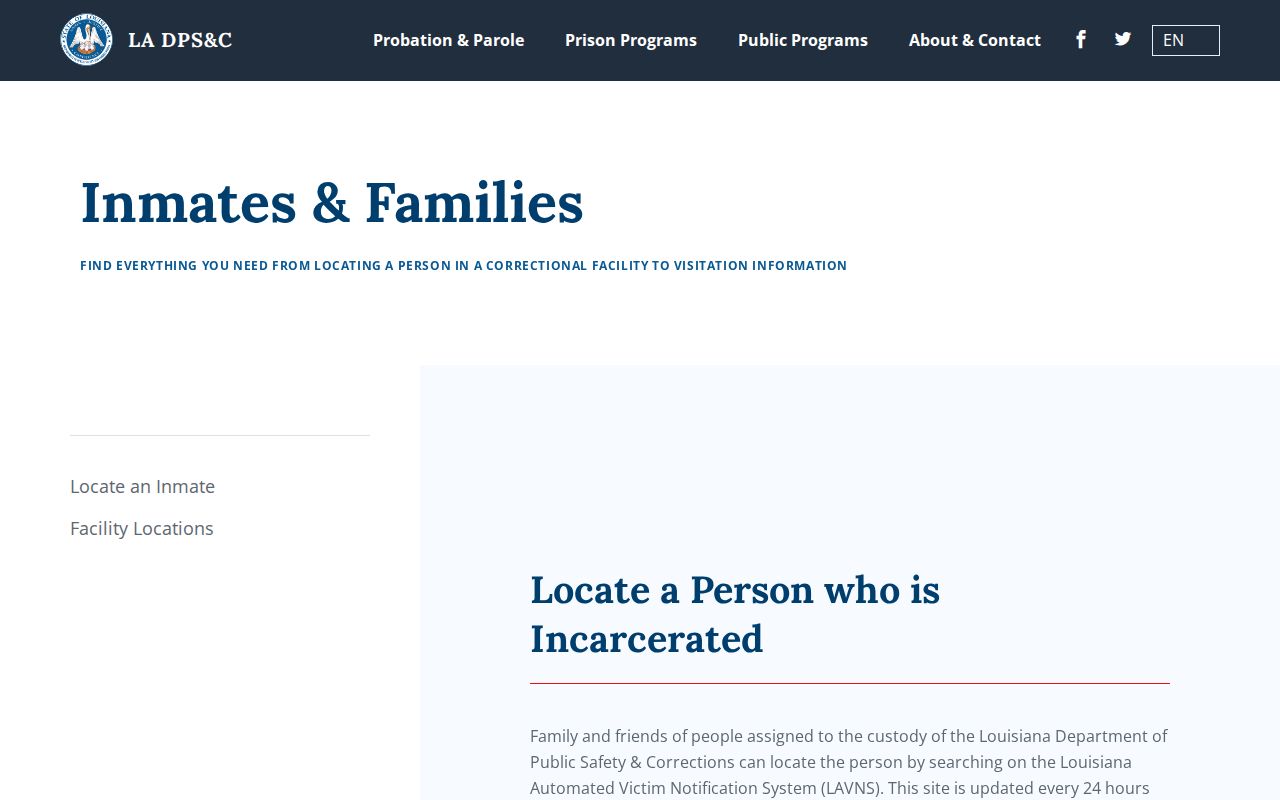
The agency information should be matched to the person’s judgment and identifier because a name alone can lead to the wrong record.
Livingston Pretrial Dates Stay Unfixed
A person held before trial does not have a sentence-completion date. Release may turn on bond, a judge’s order, dismissal, a plea and sentence, or transfer. The LPSO-linked TBS roster may display charges, a bond label, booking details, and a fugitive-hold field, but those entries do not prove a bond was posted or an exit occurred.
Ask LPSO under Sheriff Jason Ard about current custody and any known hold through the official Detention Center page. Then check the 21st JDC criminal docket channel for the legal action. If release occurs, the sheriff movement record supplies the actual time, reason, releasing authority, and destination when disclosable. A court minute can explain why release was authorized, but it may not match the physical departure time.
Note: Do not calculate a pretrial release date from a bond amount, court date, or a missing name on the current roster.
Livingston Legacy Release Calculations
For offenses committed before August 1, 2024, Louisiana R.S. 15:571.3 supplies the legacy framework and transition rules. The result depends on offense date, conviction class, prior history, exclusions, and whether a parish sheriff or DPS&C administers the sentence. A single percentage cannot state the rule for everyone.
The familiar 85 percent phrase comes from one violent-offense calculation in which three days may be earned for each seventeen days actually served. That arithmetic does not govern all Louisiana sentences. Other eligible groups, excluded offenses, habitual-offender terms, and statutory amendments produce different results. The custodian decides whether credit has been earned and applies the correct cohort.
For a qualifying parish prisoner sentenced without hard labor, the legacy statute has included parish-administered diminution rules. That does not authorize the public to compute an official Livingston Parish date. Start with the judgment and ask the responsible custodian for the current time computation.
The enacted legacy diminution statute is shown in the matched source image below.
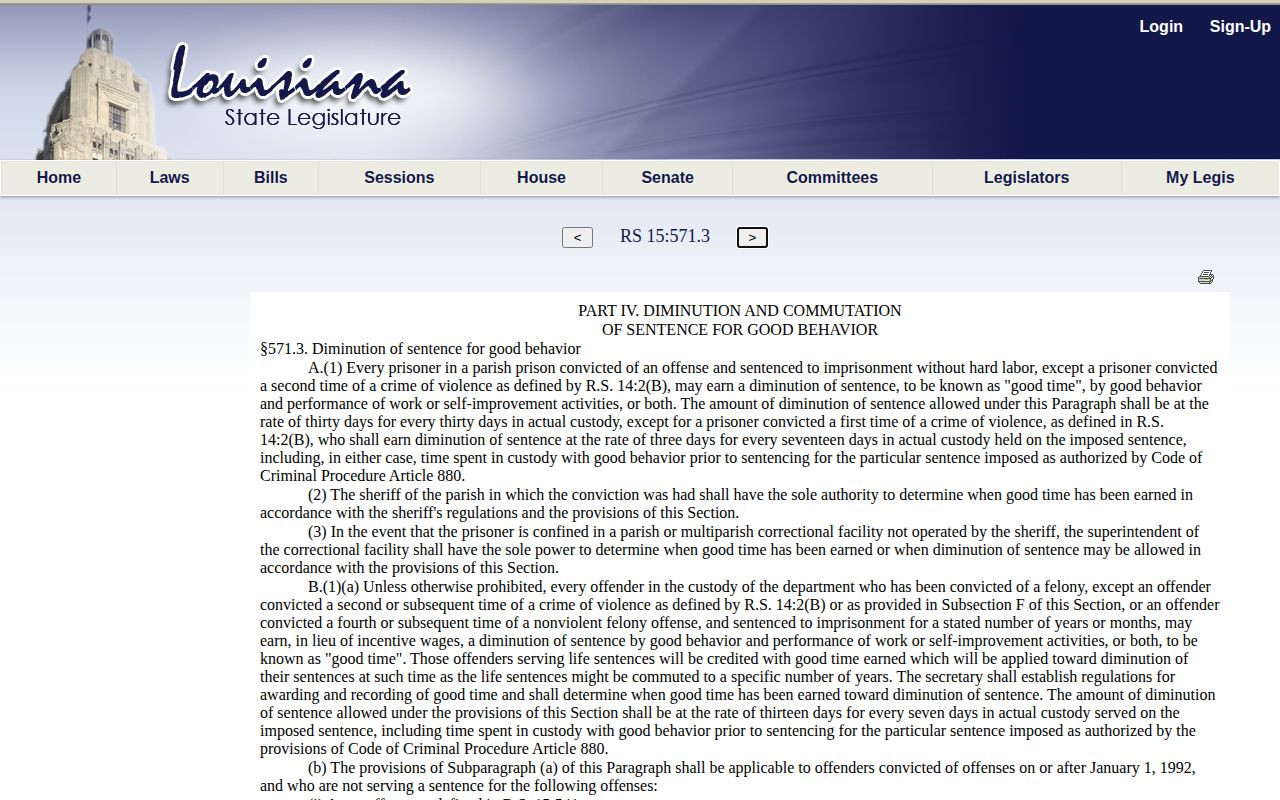
The statute’s cohort detail is why an offense date and sentence class must be verified before anyone interprets a projected release date.
August 2024 Livingston Release Divide
Offenses committed on or after August 1, 2024 fall under a different core rule. R.S. 15:571.3.1 allows an eligible felony offender in parish prison or DPS&C custody to earn good-behavior diminution up to a maximum of fifteen percent of the sentence imposed. “Up to” matters. The credit is not automatic.
The statute excludes a person convicted of a defined sex offense and a person sentenced as a habitual offender from that subsection. It permits added programming diminution for eligible people under a separate provision, with exclusions. The new-law cohort also does not earn good-time credit on presentence time served under the cited rule. Earned credit remains subject to forfeiture.
If the full maximum applies, the basic arithmetic leaves 85 percent of the imposed sentence. That does not make “serve 85 percent” a safe universal answer. Eligibility, program credit, forfeiture, split sentences, and other terms still matter. DPS&C or the authorized parish custodian supplies the official computation.
Release under this diminution rule may leave the rest of the full term running as if on unsupervised parole. A split-sentence recipient begins probation, with the unsupervised term running concurrently when the statute applies. Physical release is therefore distinct from full discharge.
Missing Livingston Release Date Results
The DPS&C locator is strongest as a current location and projected-date channel. The official sources reviewed do not promise that every discharged person stays searchable, that every result carries an actual release label, or that former profiles remain for a fixed period. An absent hit cannot be called proof of release.
Spelling, identifier mismatch, transfer, timing, confidentiality, or lack of a DPS&C sentence can all explain a missing result. Call the state locator and compare the answer with the court judgment. If documentary proof is needed, ask for the releasable face sheet, time-computation sheet, release certificate, or discharge record held by the right custodian.
This is also where jurisdiction matters. A person released on bond from Livingston Parish Detention Center may never have a meaningful DPS&C locator record. Use the sheriff and court path for that episode. The state search is not a parish recent-release list.
When a former state record cannot be located, a narrow public-record request can seek an existing release or discharge document without demanding protected prison material. Give the full name and variants, date of birth, DPS&C number, sentencing parish, docket, approximate admission and release dates, and known facility. Ask for the releasable face sheet showing final custody status, the final time-computation sheet, or the release certificate. The custodian may redact confidential information while producing a nonexempt portion.
Louisiana R.S. 44:33 and 44:35 govern availability and enforcement timing, but they do not promise full production in a fixed three-day or five-day window. A record in active use can produce a certified availability date. The five-day provision addresses the lack of a written determination or reasonable-time estimate after the statutory period, excluding weekends and legal holidays. It is not a universal delivery deadline for every computation file.
Changes to Livingston Release Dates
A projected date can move in either direction as the legal and administrative record changes. Some factors alter earned credit. Others change how long the underlying terms run or prevent community release when one custodian’s sentence ends.
| Factor | Effect on the date | Best confirmation |
|---|---|---|
| Earned diminution | May move an eligible projected date earlier | Current custodian computation |
| Credit forfeiture | May move the estimate later under R.S. 15:571.4 | DPS&C or parish computation record |
| Concurrent or consecutive terms | Changes how multiple sentences overlap or stack | Judgments and sentence calculation |
| Detainer or hold | May cause transfer or continued custody after one term ends | Holding agency and movement record |
| Later court order | Can amend, vacate, credit, or otherwise affect a sentence | Signed order and updated computation |
| Parole action | May create a conditional release path but not an instant exit | Official action, DPS&C status, and release record |
R.S. 15:571.4 is the official source for forfeiture. Do not assume a disciplinary event changed the date without the custodian’s applied computation.
Confirm Livingston Actual Release Dates
VINE can alert users to covered custody changes in Louisiana parish jails and state prisons. Registration is useful while a person remains in custody, but the alert must be read literally. A transfer notice means continued custody. A release notice should be preserved and checked against the agency record. The Livingston VINE inmate check details the local and statewide notification layers.
After the event, ask the responsible custodian for actual release date and time, release type, releasing authority, and destination or transfer agency when recorded and disclosable. For a Livingston Parish booking, LPSO requires its formal public-record request by United States Mail. For a state sentence, identify the DPS&C number, sentencing parish, docket, approximate dates, and exact document sought.
A final check compares three items: the court authority, the agency computation, and the actual movement or discharge record. Together they answer why release was possible, when it was expected, and what occurred. One field should not be made to answer all three questions.
If another agency takes custody, record both events. The first custodian may show a completed release or transfer while the person remains confined elsewhere. A detainer is a request or authority for another agency to hold or take the person. It can prevent a projected community exit without changing the end date of the first sentence in the way a new court order might. The movement record and receiving agency status resolve that difference.