
Livingston Parish Supervision Types
Parole and probation both allow a person to live outside a jail or prison under legal terms, but they begin in different ways. Parole is a conditional release from a prison sentence. Felony probation is imposed by a court and may follow jail time, a suspended prison term, or a split sentence. Misdemeanor probation is also court ordered, but Livingston Parish directs those questions to a separate local office. None of these labels proves the exact date or route by which a person left a facility.
The agency split matters. Louisiana DPS&C supervises parole and felony probation through its Division of Probation and Parole. The 21st Judicial District Court handles Livingston Parish misdemeanor probation questions. An official release or court record should be paired with the office response because a supervision record and a custody release record answer different questions.
| Status | How it begins | Livingston verification route |
|---|---|---|
| Parole | Conditional release from a prison sentence | DPS&C, the Amite District, and the official parole action |
| Felony probation | Sentence or suspended term imposed by the court | Amite Probation and Parole plus 21st JDC case minutes |
| Misdemeanor probation | Local court sentence | 21st JDC Misdemeanor Probation office and court record |
| Unsupervised parole | Remainder of a qualifying term after diminution release | DPS&C computation or discharge record |
| Discharged | Sentence and any required supervision have ended | Final discharge record and court or DPS&C confirmation |
Verify Livingston Parish Post-Release Supervision
There is no verified statewide public name roster for every person on Louisiana parole or probation. A sound check starts with identity and jurisdiction, then uses the supervising office and the record that created the status. Have the full legal name, date of birth, DPS&C number if known, sentencing parish, and court docket number ready. Name-only inquiries can confuse people with similar names.
- Determine whether the case was a Livingston Parish misdemeanor, a felony sentence, or another parish or federal matter. The docket and minute entry provide the best starting point.
- For parole or felony probation, check Louisiana custody information through DPS&C and contact the Amite District. Ask only for information the office may lawfully disclose.
- For misdemeanor probation, contact the 21st JDC Misdemeanor Probation office rather than the state district office.
- Compare the response with the sentencing minute, parole action, release certificate, or DPS&C computation record. A scheduled event alone is not a final status.
- If documentary proof is needed, request the releasable portion of the exact supervision, release, or discharge record from its custodian.
Supervision files can contain confidential reports, addresses, risk material, and internal notes. Louisiana R.S. 15:574.12 protects broad categories of presentence, pre-parole, prison, and Board information. A focused request for the public action or discharge status is more likely to yield a clear response than a demand for the entire file.
Livingston Felony Supervision Uses Amite
Livingston Parish does not have a state probation district bearing the parish name. The current DPS&C district brochure assigns the local office to Amite, and jurisdiction material covers Livingston, St. Helena, and Tangipahoa parishes. This explains why a search for a Livingston office can fail even when state supervision is active. Confirm the listing through the DPS&C office directory before travel because assignments can change.
Amite Probation and Parole District
P.O. Box 955
1209 Northwest Central Avenue
Amite, LA 70422
(985) 748-2013
The official material reviewed does not publish office hours for this district. Call first. Staff may be able to confirm a public status or route a records question, but they may not release confidential supervision details. The geographic location is only an office assignment. It does not show where the person lives, where the person was released, or whether the person is currently in custody.
The Livingston Parish Clerk FAQ gives the local split in plain terms: felony probation questions go to state Probation and Parole, while misdemeanor probation questions go to the 21st JDC office. This is the research-backed local route, not a general state assumption.
Livingston Misdemeanor Probation Split
Misdemeanor probation in Livingston Parish follows the 21st Judicial District Court route, not the Amite felony supervision route. The Clerk directs inquiries to the 21st JDC Misdemeanor Probation office at (985) 747-1308. A court minute or disposition should show whether probation was imposed, changed, revoked, or completed. It can also distinguish probation from a jail release based on bond, dismissal, or time served.
That distinction prevents a common error. A person may be outside the detention center because a judge imposed probation, yet the person may never have served a state prison term or gone before the Committee on Parole. Conversely, a parolee may have a Livingston connection but be supervised under a state case that calls for the Amite office. The case number and sentencing court keep the inquiry tied to the correct authority.
Note: A court disposition explains the legal status, while the sheriff release record supplies the actual jail departure time and movement details.
Livingston Release Status Distinctions
Louisiana’s newer diminution law makes precise labels vital. Under R.S. 15:571.3.1(F), a qualifying good-time release can place a person on a status treated as unsupervised parole for the remainder of the full term. A person released from a split sentence begins the judicial probation period, with any unsupervised-parole term running at the same time. Physical release, therefore, does not always mean full discharge.
- Supervised parole
- Conditional community release with active state supervision after a prison sentence.
- Probation
- A court-ordered community sentence, which can be supervised through the state or local court office.
- Unsupervised parole
- A statutory status that may follow qualifying diminution release without routine active supervision.
- Discharge
- The formal end of the sentence or supervision term, as shown by the responsible agency record.
- Transfer
- Movement to another custodian, not release to the community.
The labels should come from the court, DPS&C, or the official release document. Do not infer them from a missing roster entry. For a parish custody episode, the LPSO Detention Center channel under Sheriff Jason Ard supplies the local starting point. The broader Livingston Parish release-record search explains how to pair the jail movement record with a court disposition when the physical exit itself is at issue.
Livingston Parole Dockets Need Follow-Up
The Louisiana Committee on Parole publishes dated notices and agendas through the official parole docket page. A listing may identify an applicant, DPS&C number, judicial district, hearing method, and start time. DPS&C guidance says docket pages are updated at noon Monday through Friday and remain subject to change.
A docket is a schedule, not a release record. Appearance on it does not mean parole was granted. After the meeting, obtain the official action, minute, or decision notice, then check custody status and the Amite office when applicable. Outcomes may include a grant, denial, deferral, recess, rescheduling, or another case-specific action. Even a favorable vote can remain subject to conditions, a detainer, rescission, or later proceedings.
The eligibility law, Louisiana R.S. 15:574.4, contains different rules for different offense and sentence groups. Eligibility only identifies when consideration may be possible. It does not create a hearing on a set date or order physical release.
The official parole docket page is visible in the captured state source below.
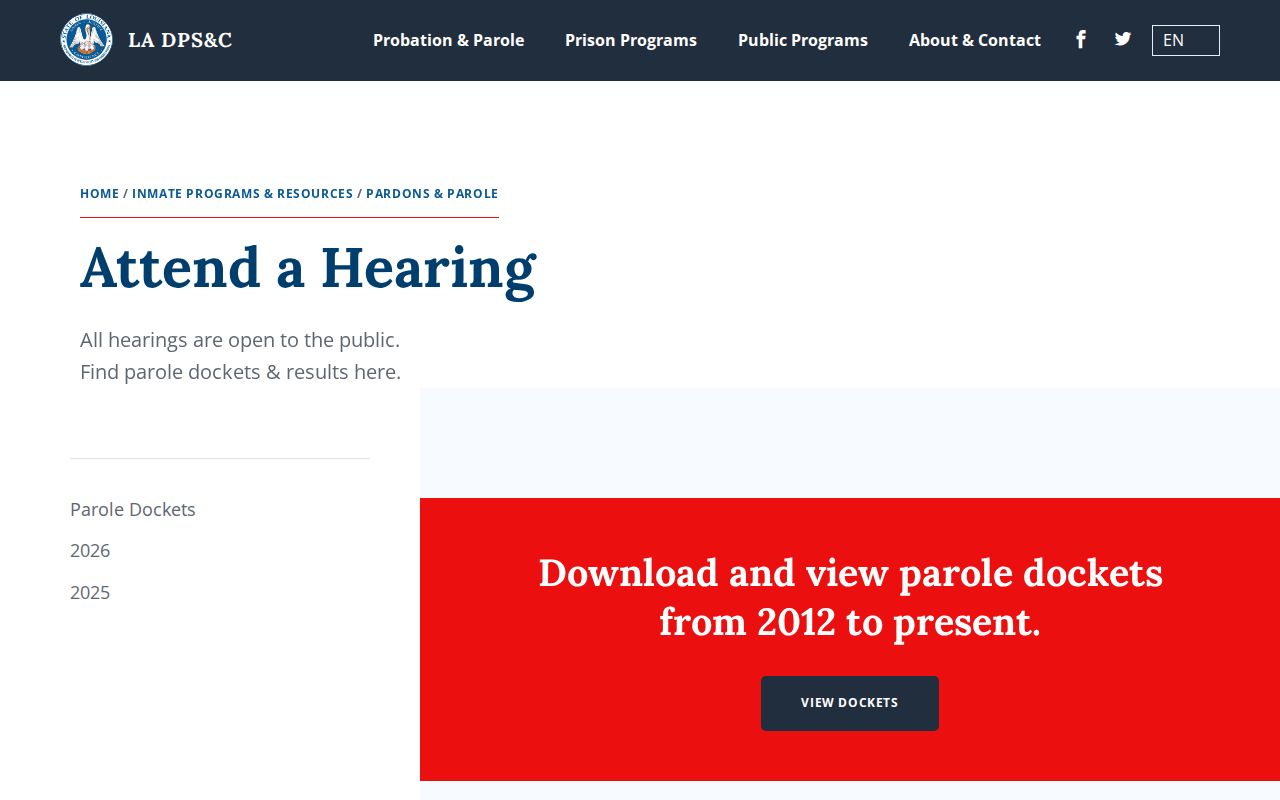
The image should be read as a point-in-time gateway to notices and actions, not as proof that a listed person left custody.
Livingston Supervision Violations and Warrants
Conditions vary by order and status. At a high level, they may require reporting, compliance with court or agency directions, and lawful conduct. Only the governing order and supervising office can establish the actual terms for one person. A public summary cannot safely fill in conditions that the record does not state.
An absconder is a person alleged to have stopped reporting or left supervision without authorization. An absconder notation or parole warrant can expose the person to arrest and a return-to-custody process. It is not proof of a new conviction. It also does not show that the person is already in jail. No verified statewide public absconder name search covers all Livingston Parish supervisees, so use the Amite office, court record, and custody systems rather than an invented online roster.
If a custody change may occur, Louisiana VINE can provide alerts for covered jail and prison events. An automated alert still needs confirmation. A transfer, warrant execution, and community release are different events.
Livingston Supervision Ends by Discharge
Supervision ends through an authorized discharge, expiration, court action, or other status-specific process. The proof depends on how the status began. A probation discharge is grounded in the 21st JDC criminal case record and supervising office response. A parole or state diminution discharge comes from DPS&C. The parish jail roster does not certify either event.
For a focused public-record request, identify the person, date of birth, DPS&C number, sentencing parish, docket, approximate release period, and the exact existing item sought. Useful terms include the public portion of a discharge record, final release certificate, Committee on Parole action, or releasable face sheet showing custody status. Ask the custodian to redact protected details and produce the rest. Louisiana’s Public Records Law does not require an agency to create a new explanation.
A final discharge should not be confused with a favorable hearing, a projected date, or a lack of current roster results. Each is a lead from a different point in the process. The signed court order or agency record supplies the durable answer.